
I’ve been venturing around the internet for over fifteen years.
In that time I picked up experience across several different but connected things such as automation, productivity, the tools I build with, writing.
On paper those look like separate niches.
In practice they’re all the same thread: one person’s way of thinking about building things online.
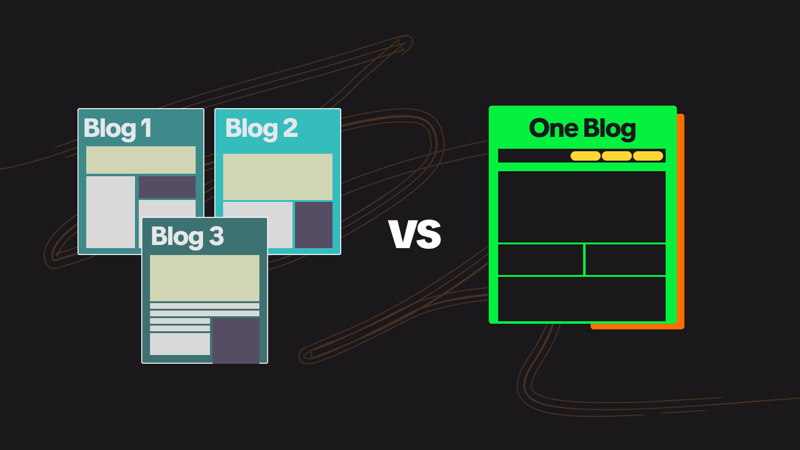
So when I started The Owl Logic, the choice was right in front of me. Spin up a separate blog for each topic, or put everything under one roof.
I went with one domain and multiple categories – a personal brand, not a single-topic site. That was a deliberate decision.
Most “one blog vs many” advice gives you a blanket rule and moves on.
The real answer depends on a single test, and once you see it, the decision makes itself.
The honest answer
Start with one blog. As a beginner, running multiple sites splits your time, budget, and authority across blogs that each need years to grow – so they all stagnate together.
If your interests connect by a common thread, put them as categories under one domain instead of separate sites; that concentrates your authority and still lets you cover everything.
The only time separate blogs make sense is when your topics are genuinely unrelated — and even then, master one first before starting a second.
Focus beats diversification when you’re new.
Why one blog wins when you’re starting out
Every blog is a separate mouth to feed. Its own domain, its own hosting, its own year-long climb to earn Google’s trust, its own pile of content before it ranks for anything.
Run one and that’s already a serious commitment.
Run three and you’ve tripled the workload while cutting the attention each one gets down to a third.
The authority problem is worse, though.
When you publish consistently on one site, every post strengthens the whole thing – your best articles lend credibility to your newest ones, and the domain as a whole gets stronger over time.
Split that across three separate sites and each one starts from zero, alone, fighting for trust on its own.
You’ve taken the one advantage that compounds and divided it by three. but it comes up with a risk well, I have explained why in below section.
For a beginner, that math is how all three blogs stall at once.
There’s a cost angle too. Three domains, three hosting plans, three sets of tools, or three free plans stretched thin.
It adds up fast before any of them are earning. One domain lets you put every resource into one thing until it’s working.
The real test: are your niches actually connected?
Here’s where the blanket advice falls apart. “Always run one blog” isn’t the full answer either.
The real question is whether your topics share a thread.
Mine do. Automation, productivity, writing, the tools I use – they’re different categories, but they point at the same kind of person doing the same kind of thing: building something online, mostly solo, trying to be efficient about it.
A reader who comes for one of those topics could plausibly care about the rest, because it’s all the same world.
The thread isn’t the topic. It’s the perspective.
(I went into this in depth over at personal brand blog vs niche blog – worth reading alongside this one if you’re trying to figure out what shape your site should take.)
Now picture the opposite: a food recipe blog and a personal finance blog under one domain.
Those don’t connect. There’s no shared reader, no shared thread, no perspective that makes them belong together.
A visitor lands and can’t tell what the site is about. Neither can Google. That’s not a broad blog, that’s two unrelated projects stapled together.
Those deserve separate homes.
(But I got your thought here, Maybe food recipe blog, can create partial financial type of blog because shopping advice, and yeah that may sounds like a worth shot – Yes. PERSPECTIVE)
So here’s the test: could one reader plausibly care about all of it?
Yes → one blog with categories.
No → separate projects.
It’s a blunt test. That’s what makes it useful.
One domain, many categories – how to do it
If your topics pass the connection test, categories are the move.
You cover everything you care about, all of it builds a single compounding pile of authority, and none of your energy escapes to a site that starts over from zero.
The key is keeping the categories tight enough that the site still has an identity.
A personal brand can hold several topics as long as you’re the obvious thread.
Your perspective is what makes “automation” and “blogging” belong on the same domain, not a rigid topic rule, but your specific way of thinking.
Lead with that, and the breadth becomes a strength instead of a smell.
When multiple blogs actually make sense
Two situations earn a second blog.
The topics genuinely don’t connect
If you’re serious about two worlds with no shared reader the food-and-finance problem separate sites are honestly the right call.
Forcing them together dilutes both. The reader who finds your recipes doesn’t want a budgeting guide in their feed, and Google reads the mismatch. Build them separately.
You’ve already mastered the first one
Once a blog is established, earning, and running well, a second becomes a real option rather than a distraction.
Not before. Starting three sites at once is three slow failures.
Starting one, earning the right to expand, and then building a second from a position of experience and income – that’s how it actually works.
Questions people actually ask
Can I have multiple niches on one blog?
Yes, if they connect. The test is whether a single reader could plausibly care about all of them.
If they share a thread (your topic, your audience, your perspective), run them as categories under one domain.
That concentrates authority instead of splitting it.
The only time multiple niches don’t belong together is when they’re genuinely unrelated – no shared reader, no shared thread.
Is it bad to run multiple blogs?
For a beginner, usually yes. Each blog needs its own time, budget, and years of authority-building, so running several splits your effort and they tend to stall together.
Multiple blogs can make sense once you’ve mastered one and have the bandwidth, or when your topics are so unrelated they genuinely can’t share a site.
How many blogs should a beginner start?
One. Put all your time, energy, and content into a single site until it’s working.
Cover multiple interests as categories under that one domain if they connect.
A second blog is something you earn by making the first one work – not something you start alongside it.