
When I launched my blog, the early weeks were super quiet – exactly the way everyone warns you they’ll be. And the traffic that did trickle in early? It didn’t come from Google. It came from going out and getting it myself.
That’s year one. Not a launch that takes off.
A slow ramp that stays flat longer than feels fair, then bends upward late, and the traffic you get before the bend is mostly traffic you went out and earned by hand.
If you’re reading this because you’re staring at your own stats wondering am I behind, or is this normal or Do I need to change my perspective on Blogging goals? – that’s the exact question this post answers.
The honest answer for your blogging goals
Little traffic for the first few months, SEO starting to compound around months 6–12, and often little or no income until late in the year. The real win in year one isn’t money – it’s publishing 20–40 solid posts and building the habit.
If you expect viral traffic or quick income, you’ll quit. Expect a slow, compounding curve and you’ll still be here when it pays off.
The shape of a normal year one
These are honest ranges, not promises – your niche, your effort, and how much you promote swing them hard. But this is the curve most new blogs actually ride:
- Months 1–3: Near silence from Google. A new site has earned no trust, so search sends almost nothing, a trickle on a good day. Income is effectively zero. This is where most people quietly conclude they’re failing. They’re not. The engine just hasn’t warmed up.
- Months 4–6: The first signs of life. A few posts start ranking for low-competition terms, search traffic creeps from a trickle to a thin but real stream, and maybe you see your first few dollars. Still mostly flat, but no longer dead.
- Months 7–12: Compounding starts to show. Older posts climb, new posts rank a little faster because the site has some trust now, and traffic that crawled to hundreds can start reaching into the thousands. Income often shows up here too, but realistically it’s small. First-real-money territory, not replaces your 9-5 salary.
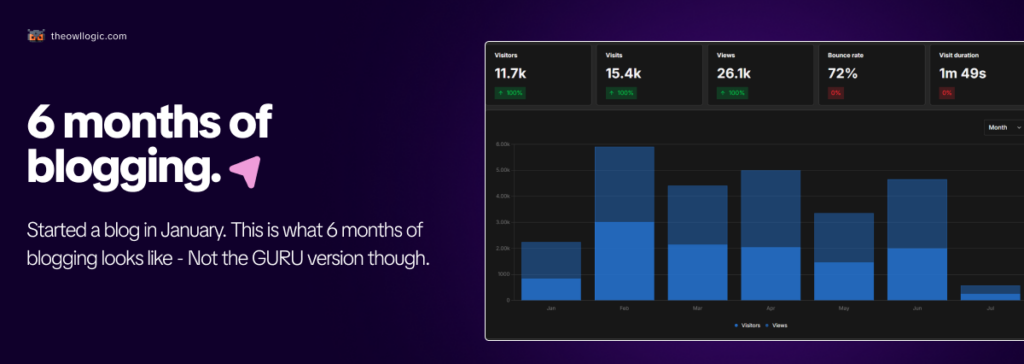
Now the part that’s the whole lesson. The traffic I had in those early months was above what a typical Google-only year-one blog sees – and the reason is simple: (check the above stats)
I didn’t wait for search. I went and got the traffic myself, from communities like Reddit, facebook, bluesky and etc, while the SEO compounded quietly underneath.
So if your search numbers look like “Months 1–3” up there, you are not failing. You’re dead-on the normal curve. You can choose to beat it the same way.
Why it’s slow? and why slow isn’t the problem
Blogging is slow by game with lots of hard work.
Google has to learn it can trust your site, and that trust is earned over months of consistent, useful content – never bought with one big burst of effort.
So the early curve stays flat no matter how talented you are.
Slow isn’t the failure. Expecting fast is.
When you walk in expecting traffic by week three, the normal slow ramp reads as proof you’re bad at this, and you quit during the exact stretch that was about to pay off.
That’s the number-one way new blogs die; I broke it down in why most blogs fail in year one. Right expectations aren’t a nicety here.
They’re the thing that keeps you in the game long enough to reach the compounding. (And if you’re still asking whether the payoff is even real, that’s is blogging worth it in 2026.)
In year one, money is the wrong scoreboard
Here’s the reframe that changes how the whole year feels: if you measure year one by income, you’ll feel like a failure for ten months straight because the income mostly isn’t there yet, and that’s normal, not personal.
So measure the things you actually control and that actually build the asset:
- Publish 20–40 solid posts. This is the real year-one target. It’s the content base everything else compounds on top of.
- Build the habit. A publishing rhythm you can hold for a year is worth more than any single post that pops. The habit is the engine.
- Learn your reader. By month twelve you should understand what your audience actually wants far better than you did on day one. That knowledge compounds too.
Hit those three and the traffic and money arrive in year two — paid out of the trust you spent year one earning.
“Am I behind?” – almost certainly not
The anxious question under all of this is is my slow progress normal, or am I just failing? In nearly every case: normal. Barely any traffic for the first few months, near-zero early income, a handful of posts that go nowhere – that’s the standard experience, not a red flag.
You’re only genuinely behind in one situation: you’ve stopped publishing, or you’re a year in with no consistent body of content.
Slow growth on a blog you’re still feeding is just blogging working as designed. Stay in it.
Questions people actually ask
How much traffic should a blog get in the first year?
From Google alone, honestly very little for the first several months – often only tens to low hundreds of visits a month until SEO begins compounding around months 6–12. By the end of year one, somewhere from a few hundred to a few thousand monthly visitors is a realistic range, swinging heavily on niche and effort.
You can go well beyond that by promoting outside Google – early on, communities like Reddit can bring in real readers while your search traffic is still building.
When does a blog start making money?
Usually late in year one at the earliest, and even then it’s typically small. Meaningful income generally lands in year two, once you have enough ranking content and traffic to monetize properly. Expecting real money in the first few months is the fastest route to disappointment, and quitting.
Is slow blog growth normal?
Yes , it’s the default. A blog’s traffic curve stays flat for months, then bends upward as SEO compounds. Slow early growth almost never means you’re failing; it means the engine hasn’t warmed up yet. The only real failure is quitting during the flat stretch, right before it starts to climb.