
If you’re planning your blog before you start it, you’re already ahead of where I was for years.
I used to just start. Pick a topic on a whim, start writing, hope it went somewhere. It never did. A blog with no plan is a headless chicken: it runs hard and goes nowhere.
You’re not doing that, and that instinct is most of the difference between the blogs that make it and the ones that don’t.
What planning actually buys you is control. Once you’ve decided what you’re writing about, how serious you are, what it’ll cost, and what to realistically expect, you’re steering instead of guessing.
That feeling of control is most of what expensive blogging courses are really selling. This guide hands it to you in one place, for free.
The short answer
Planning a blog is twelve decisions made in a specific order, and you can finish all of them in an afternoon. Four stages: what you’ll write about, who you are and how serious, what it costs, what to expect. The order matters more than any single answer, because each call narrows the next one. Make them up front and you start from a plan instead of a guess.
The Blog Planning Decision Map
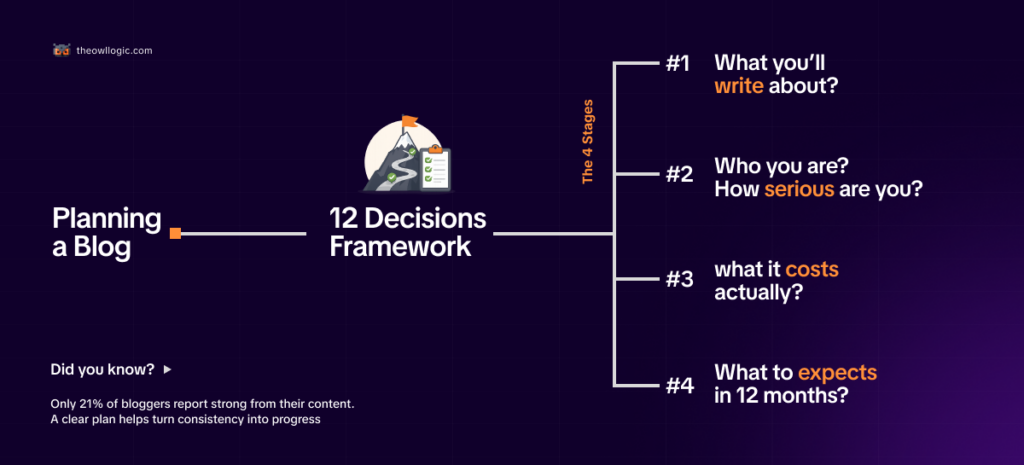
Planning a blog is twelve decisions, grouped into four stages, made in order. That’s the entire planning phase. Here’s the map:
- What you’ll write about: is blogging worth it, your niche, how narrow to go, one blog or several.
- Who you are and how serious: personal brand or niche site, real name or anonymous, side hustle or full-time.
- What it costs: what you’ll actually spend, and free or self-hosted.
- What to expect: why blogs fail, what year one looks like, your first ten posts.
Make them in that order and each decision narrows the next one. Make them out of order and you’ll relitigate the same call three times.
How long does it take to plan a blog?
An afternoon. A weekend if you’re genuinely torn on the niche.
Twelve decisions sounds like a lot. It isn’t, because most of them are single calls with an obvious answer once you’ve heard the honest version: one blog, real name, side hustle, self-hosted.
Only two really deserve your thinking time: your niche, and how narrow to go. Those two shape everything downstream.
There’s a failure mode on this end of it, too. Planning can quietly turn into the procrastination: another week of research, another comparison, another decision reopened, and all of it feels productive precisely because it isn’t writing.
A rough plan you committed to on Sunday or Saturday beats a perfect plan you’re still polishing in October. Make the calls, write them down, go build the thing.
Stage 1: What you’ll write about

Get this stage roughly right and everything after it gets easier. Get it wrong and you’re rebuilding in six months.
Is blogging still worth it, or am I too late?
Yes, with a condition: it’s a long game now, not a traffic hack. The blogs winning today aren’t the ones that gamed an algorithm, they’re the ones that stayed useful and stayed consistent.
If you’re still on the fence, settle whether blogging is still worth it in 2026 before you spend a cent.
What’s your niche? (The niche related questions)
Pick good-enough, not perfect. This isn’t a life sentence, and the beginners who freeze here lose months to a decision they could revisit any time.
A three-part filter does the work: a topic you won’t quit in six months, where people actually spend money, and where you have something useful to say.
The intersection is your niche, and this filter will get you unstuck in about an hour if you’re stuck on the actual pick.
How narrow should you go? (Narrow feels small, Start anyway)
Start micro. Width is a phase, not a cage. A narrow niche is far easier to rank for while you’re new, and you broaden into adjacent topics once you’ve earned the authority, so the rule is micro now, broaden later. Knowing when to start narrow and when to widen out is its own call.
One blog or several? (I have different interests)
One. Running several splits your time, money, and authority across sites that each need years to grow, so they all stall together.
Multiple interests aren’t a reason for multiple blogs; they’re categories under one domain, as long as they share a thread. Only genuinely unrelated topics justify separate sites, and there’s a fuller case for why focusing on a single blog beats spreading yourself thin.
Stage 2: Who you are and how serious
Two of these shape your domain name. Make them before you buy one.
Personal brand or niche site? (Are you the brand, or topic)
Decide this now, because it’s the hardest one to reverse.
A personal brand is built around you: flexible, and it travels with you if your interests shift.
A niche site is built around a topic: more focused, easier to hand off or sell, less flexible. Neither is wrong, but it quietly shapes your domain, your voice, and how you write, so it’s worth seeing how a personal brand and a niche site really differ.
Real name or anonymous?
Use your real name. The urge to hide usually isn’t about privacy at all, and anonymity strips out the trust that makes a blog work in the first place.
Go anonymous only for a genuine reason: real privacy needs, a sensitive niche, or distance from your career. If you’re wrestling with it, I make the honest case for using your real name over blogging anonymously.
Side hustle or full-time?
Start on the side, every time. Blogs take 12–18 months to earn meaningfully, so quitting your job early just piles on pressure that makes you write worse and quit faster.
Go full-time when the blog replaces a real chunk of your income: a number, not a feeling. There’s a fuller take on when it actually makes sense to go full-time.
Stage 3: What it costs
This is where beginners either freeze or overspend. Neither is necessary.
What it actually costs (It costs less than you’ve been told)
A domain and hosting. That’s the only genuinely required spend, and it’s roughly $0–100 for your entire first year. Ignore the “you need $500” numbers; those are written by people selling you the $500 of stuff.
Everything else waits until the blog earns, because spend follows income and never the other way around, which is the logic behind what it actually costs to start a blog, line by line.
Free or self-hosted? (Is free good enough)
Free isn’t free. It’s rented: you don’t own the site, you can’t fully monetise it, and the platform can change the rules or remove you.
That’s genuinely fine for testing an idea or a pure hobby, but if you’re serious about growing or earning, self-host on WordPress.org with cheap shared hosting. I weigh up the free-versus-self-hosted decision in full if you’re torn.
Stage 4: What to expect
This is the stage most beginners skip, and it’s the single biggest reason they quit.
Why most blogs fail (It’s not that you’re not good enough)
Not talent. Quitting, in the first 6–12 months, right before SEO traffic starts to compound.
People leave during the flat stretch and conclude blogging is dead; it wasn’t dead, they left early. It’s worth understanding why most blogs quietly die in year one before you’re in the middle of it.
What year one really looks like (Months where nothing happens)
A slow ramp, and mostly not a paycheck. Traffic stays thin for months, SEO starts compounding somewhere around 6–12, and income usually arrives late if at all.
Measure year one by money and you’ll feel like a failure for ten months straight, so measure it by output instead: 20–40 solid posts and a habit you can sustain.
Check your start against what year one realistically looks like so a slow ramp doesn’t trick you into quitting.
Your first 10 posts (Maybe first 10 drafts)
Not ten ideas. A structure. Plan them around one core topic so they link together into a mini cluster that signals focus from day one, instead of a scatter of unrelated posts that never rank.
Here’s how to plan those first ten posts so they build on each other.
Put the plan together, then start
That’s the whole planning phase. Topic, scope, identity, commitment, costs, platform, expectations: decided, in order, before you’ve written a word.
You’re no longer the headless chicken. You’re someone with a map that could really make the blog into an income machine.
The next phase is setup: registering your domain, getting hosting live, configuring your blog. But that’s a job for after the thinking is done, and the thinking is exactly what most people skip on their way to quitting. You didn’t skip it. That alone puts you ahead of most blogs that will start this year.
Questions people actually ask
What should you decide before starting a blog?
Before starting, decide: your niche and how narrow to go, whether it’s one blog or several, real name or anonymous, side hustle or full-time, what it’ll cost, free or self-hosted, and what to realistically expect in year one. Making these calls up front means you start from a plan instead of guessing your way forward and quitting when it gets hard.
Do I need a plan to start a blog?
You can technically start without one, but you’ll likely flail, publish scattered content, and quit when results are slow. A simple plan gives you direction and control: you know what you’re building, why, and what to expect. It’s the difference between running hard with no aim and moving deliberately toward something. The plan doesn’t need to be complicated; it just needs to exist before you start writing.
What’s the first step in planning a blog?
Deciding what your blog is about: your niche. Pick a topic you won’t lose interest in within six months, where there’s real audience demand and money, and that you have something useful to say about. Everything else in your plan builds on that one decision, so make it first, without overthinking it into paralysis.